Back to top

2026 Best Types of Kraft Paper Bags for Global Buyers

Choosing the right kraft paper bags in 2026 requires more than comparing prices or printing options. Global buyers must examine paper strength, handle design, moisture resistance, filling speed, and end-use conditions. A small bakery may need a compact SOS bag, while a coffee roaster may require a laminated block-bottom bag with stronger structural support.

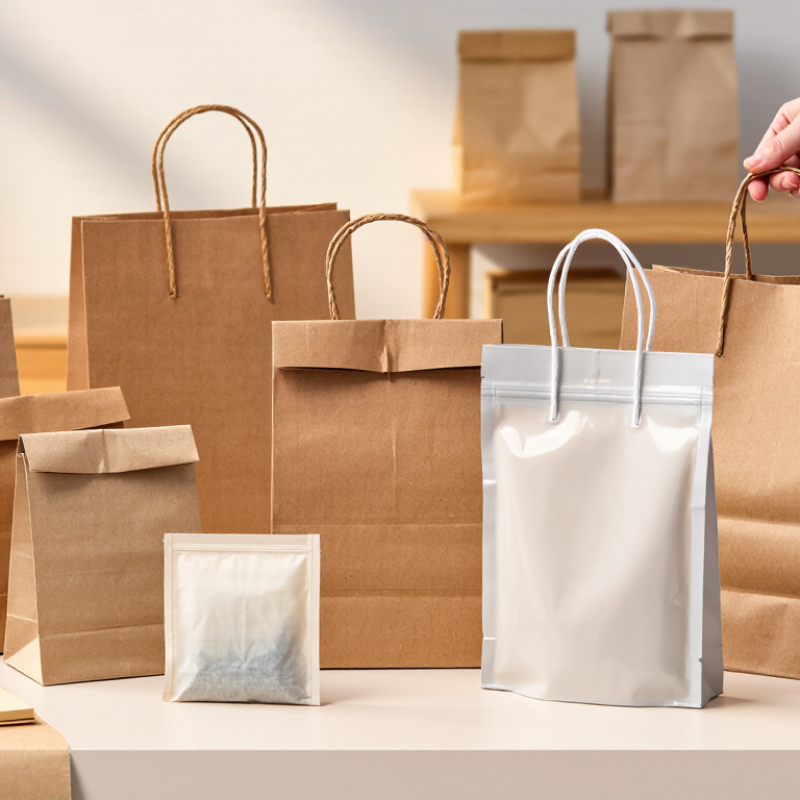
Packaging author Walter Soroka describes packaging as “the art, science, and technology of enclosing and protecting products.” This principle remains relevant to kraft paper bags. The bag must protect the product, communicate brand value, and perform reliably during storage and transport. Twisted-handle bags suit retail shopping. Flat-handle bags often support faster packing. Block-bottom bags offer better stability on shelves. Recycled kraft options can reduce virgin fiber use, but their color, stiffness, and print clarity may vary.

Details matter.

Experienced buyers should request samples and test them under realistic conditions. Fill the bag with the intended weight. Lift it repeatedly. Leave it in a humid warehouse. Check whether the base softens or the handles pull away. These simple tests can reveal weaknesses that product catalogs hide. Certification claims also deserve careful verification from recognized suppliers and independent documentation.

No kraft paper bags are perfect for every market. Some buyers overvalue appearance and underestimate loading stress. Others choose the lowest price and accept costly failures later. A better decision balances durability, material efficiency, branding, and responsible sourcing. This guide compares the best types of kraft paper bags for global buyers, while acknowledging that regional logistics and product requirements can change the final choice.
2026 Best Types of Kraft Paper Bags for Global Buyers

Kraft Bag Types by Construction: Flat, SOS, Satchel, and Block-Bottom

Flat kraft paper bags use simple folded panels and glued side seams. They are lightweight, economical, and easy to stack in cartons. Their slim profile suits takeaway items, bakery goods, documents, and small retail products. However, flat bags can collapse under uneven loads. Buyers should check paper strength, seam quality, and the actual product dimensions before ordering.

SOS bags have a square base and can stand open during filling. This structure improves packing speed and shelf presentation. Satchel bags usually have gusseted sides, giving them more internal space without becoming bulky. They work well for food, clothing, and daily retail items. In production checks, I would examine whether the gussets open evenly. Uneven folds often reduce usable capacity.

Block-bottom bags provide a stable rectangular base and strong vertical support. They are suitable for heavier goods or products needing upright display. A reinforced bottom can improve handling, but it may increase material use and shipping volume. Construction is not the only variable. Paper GSM, moisture resistance, handle attachment, printing coverage, and packing conditions also affect performance. A small sample test is wiser than relying on drawings alone. The first specification may still need adjustment.

2026 Best Types of Kraft Paper Bags for Global Buyers

This chart compares the structural features of four widely used kraft paper bag constructions. A value of 1 means the feature is typically present in that construction, while 0 means it is typically absent. The comparison describes bag architecture rather than market share or supplier performance.

Paper Grades and Strength: 60–120 g/m², Recycled Content, and ISO 536

For global buyers, kraft paper bag performance starts with grammage, not appearance. ISO 536 defines grammage as mass per unit area, measured in g/m². In practical sourcing, 60–80 g/m² paper suits lightweight retail bags and inner liners. Grades from 90–120 g/m² provide better stiffness for groceries, books, and heavier products. However, a 120 g/m² bag is not automatically stronger. Fibre quality, ply construction, seam design, and moisture exposure can change the result.

Recycled content also requires careful interpretation. CEPI’s 2023 preliminary statistics reported a European paper recycling rate of about 79%. This supports recycled fibre use, but recycled fibres are usually shorter after repeated processing. Bags may then show lower tensile strength, tear resistance, or folding durability. Buyers should request recycled-content declarations and test results, rather than relying on the word “eco.” That shortcut fails too often.

A reliable specification should combine ISO 536 grammage with tensile, tear, and burst testing. ISO 1924-2 can assess tensile strength, while ISO 1974 measures tear resistance. Ask for results in both machine and cross directions. Moisture matters, too. A bag stored beside a humid loading bay may weaken before shipment. In my view, 60–120 g/m² is a useful working range, not a universal answer. The right grade depends on load weight, handle design, transport distance, and humidity. This is where buyers sometimes under-test. A small pilot run can expose failures that a laboratory sheet cannot.

Barrier Choices for Food and Moisture: PE, Water-Based Coatings, and EN 13432

For global buyers, kraft paper bag selection often starts with the barrier, not the handle. A dry bakery item may need little protection. Fried snacks, sauces, and chilled foods demand stronger resistance to oil, vapor, and leakage. PE lining remains practical when moisture resistance and reliable heat sealing matter. It performs well during transport, especially in humid warehouses. Yet PE can complicate end-of-life claims because the bag combines paper and plastic. That detail is easy to overlook.

Water-based coatings offer a lighter alternative for grease and moisture control. They can preserve a natural paper feel and support easier recycling in suitable systems. However, coating performance depends on formulation, application weight, drying, and folding stress. Some coatings soften after prolonged contact with wet foods. Testing only a flat sheet is not enough. PE is not automatically better, either. It may resist liquid effectively while creating disposal challenges.

EN 13432 relates to industrial compostability under defined conditions. It does not mean automatic composting in a backyard or every local facility. Buyers should request complete-product test reports, food-contact declarations, coating details, and migration data. In packaging evaluations, samples sometimes pass laboratory tests but fail after folding or long storage. Real-world humidity changes everything. A credible specification should record shelf life, filling temperature, stacking pressure, and disposal route before purchase.

2026 Best Types of Kraft Paper Bags for Global Buyers - Barrier Choices for Food and Moisture: PE, Water-Based Coatings, and EN 13432

Comparative guide for selecting kraft paper bags by barrier performance, food-contact suitability, end-of-life route, and purchasing requirements. Actual performance depends on paper grammage, coating weight, seals, bag construction, and testing conditions.
Bag Construction Typical Barrier Level Moisture Resistance Grease and Oil Resistance Suitable Food Applications End-of-Life Considerations Key Buyer Checks
Uncoated Kraft Paper Bag Low barrier; breathable Low; paper absorbs liquid and humidity Low unless the paper has a built-in grease-resistant treatment Dry bakery goods, produce, grains, flour, and short-term takeaway use Generally compatible with paper recycling when clean and accepted by the local system Paper grammage, recycled-fiber content, wet strength, food-contact documentation, and recycling guidance
PE-Laminated Kraft Paper Bag High moisture barrier; good sealability High for splash, humidity, and short-term liquid exposure Good to very good, depending on polyethylene thickness and seal design Frozen foods, chilled products, sauces, pet food, powdered foods, and moisture-sensitive goods Paper-plastic composite; commonly difficult to recycle in standard paper mills. Not normally compostable PE layer thickness, laminate bond, seal strength, food-contact compliance, migration testing, and local recycling rules
Water-Based Barrier-Coated Kraft Bag Medium to high; formulation-dependent Medium to high for humidity and light liquid contact; not automatically waterproof Medium to high when specifically formulated for grease resistance Bakery products, snacks, dry foods, takeaway items, and selected chilled applications May be compatible with paper recycling if the coating and loading meet the requirements of the receiving mill; verify locally Coating chemistry, coat weight, repulpability test, fluorine-free statement where required, and food-contact declarations
Mineral or Dispersion-Coated Kraft Bag Medium barrier; optimized for specific applications Medium; performance varies substantially by coating and paper structure Medium to high for dry or greasy foods when tested for the intended use Coffee, confectionery, bakery goods, dry snacks, and powdered products Recycling and composting status cannot be assumed from the coating name; require application-specific evidence Oil and grease test results, water vapor transmission, oxygen transmission, repulpability, and intended shelf life
EN 13432-Designed Compostable Paper Bag Low to medium unless combined with a certified functional coating or lining Medium; the bag must be tested as a complete article for its intended use Medium when the grease-resistant layer is compatible with the relevant compostability requirements Dry foods, bakery items, produce, and selected food-service applications where industrial composting is available EN 13432 addresses industrial compostability criteria; it does not mean home compostability or universal acceptance in every facility Certificate or conformity evidence for the finished bag, disintegration and biodegradation results, heavy-metal limits, inks, adhesives, and disposal labeling
Multiwall Kraft Bag with Inner Liner Medium to very high, depending on the liner Medium to high for powders and bulk products Medium to high when the liner is designed for grease or oil contact Flour, starch, animal feed, dry mixes, chemicals permitted for paper packaging, and bulk food ingredients Separability of the liner is critical; composite structures may reduce paper-recycling compatibility Liner material, puncture resistance, drop testing, filling-line performance, seam strength, and disposal instructions
Important purchasing note: Barrier ratings are comparative rather than guaranteed specifications. Ask for test methods and results for water vapor transmission rate, oxygen transmission rate, Cobb water absorption, grease resistance, seal strength, and migration compliance under the actual temperature, humidity, filling, and storage conditions.

Global Compliance: FSC Certification and CEPI’s 82.5% Paper-Recycling Rate

For global buyers, kraft paper bags need more than a clean appearance. Their fiber source, certification, and recycling pathway matter. FSC certification can help verify responsible forest management and controlled material sourcing. However, buyers should check the certificate scope, license code, and validity date. A printed logo alone proves very little.

CEPI reports an 82.5% paper-recycling rate in Europe, showing the strength of established paper collection systems. This figure applies to paper recycling overall, not automatically to every kraft bag. Handles, plastic windows, wet-strength coatings, heavy inks, and mixed materials can reduce recyclability. Simple construction often performs better.

Ask suppliers for technical data, test reports, and clear material declarations. Confirm whether the bag uses virgin fiber, recycled fiber, or a controlled blend. For food packaging, request evidence covering intended contact conditions. CEPI’s recycling rate is useful context, but it is not a product certificate. FSC certification also does not guarantee perfect environmental performance. Real-world disposal remains important. A bag may be technically recyclable, yet fail when local collection is weak. This is an uncomfortable limitation. Procurement teams should review both production records and destination-market infrastructure before making a claim.

Buyer Selection Matrix: Capacity, Drop Tests, MOQ, Cost, and UN Comtrade Data

2026 Best Types of Kraft Paper Bags for Global Buyers

Buyer Selection Matrix: Capacity, Drop Tests, MOQ, Cost, and UN Comtrade Data

A useful selection matrix starts with capacity, not appearance. Small flat bags suit 0.5–2 kg retail items, while gusseted bags often handle 3–10 kg. Confirm the filled dimensions, handle strength, and paper basis weight. A 70–90 gsm bag may reduce cost, but it can fail around sharp corners. FAO forestry statistics reported approximately 416 million tonnes of global paper and paperboard production in 2022, showing the scale of this material sector.

Test the bag as shipped, not empty. ASTM D5276 or ISO 2248 drop testing can reveal torn seams, split bottoms, and handle separation. Use the buyer’s real product weight. A 1.5-meter drop sounds practical. It may still be insufficient for warehouse stacking. Moisture exposure also changes results, especially during ocean transport.

MOQ and landed cost need equal attention. Low-MOQ orders usually carry higher unit prices, while large runs may create obsolete stock. Compare paper, printing, handles, cartons, freight, and inspection fees. UN Comtrade HS 481940 data helps buyers compare exporting and importing markets, but classification quality varies. Check the declared quantity and trade value together. My sourcing reviews often find a cheaper bag becomes more expensive after reinforcement and freight. That calculation is easy to miss.

X